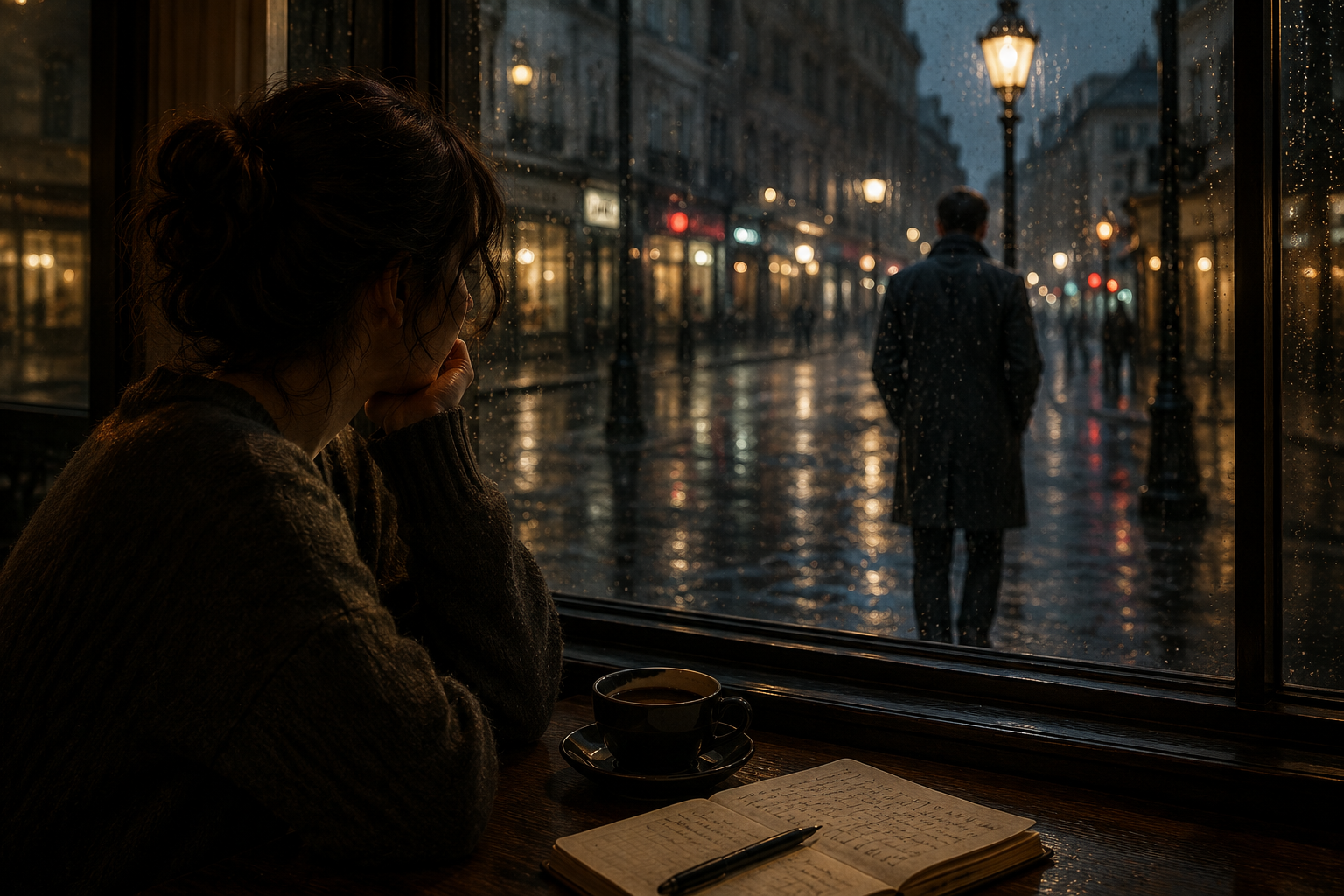
Clara first saw him on a Thursday evening in October, though for years afterward she would remember it as a Tuesday. Memory has its own calendar. It keeps the weather, the smell of wet pavement, the exact color of a stranger’s coat, and quietly loses the day of the week.
She was sitting beside the window of a small café on Bell Street, waiting for a man she had already decided not to love anymore. His name was Daniel. He was forty minutes late, which was not unusual, and Clara had spent thirty-eight of those minutes rehearsing the sentence she intended to say when he arrived.
“I can’t keep waiting for you.”
She had whispered it once into her coffee, just to hear whether it sounded final.
Outside, rain silvered the street. Umbrellas collided at the corner, buses sighed at the curb, and people hurried beneath the yellow lamps with the determined loneliness of those who believed they were late for something important.
That was when she noticed the man across the street.
He stood beneath the awning of a closed bookshop, without an umbrella, looking directly at the café window.
At first Clara assumed he was watching someone behind her. She turned. The table at her back was empty.
When she looked again, the man was still there.
He was perhaps thirty-five, perhaps forty. Tall, dark-haired, wearing a charcoal coat soaked at the shoulders. There was nothing extraordinary about him, and yet Clara felt an immediate, irrational certainty that she had seen him before.
Not his face exactly.
Something else.
The way he tilted his head. The way one hand remained in his coat pocket. The strange sadness in his posture, as though he had arrived too late and knew it.
Clara looked down at her phone.
No message from Daniel.
When she raised her eyes, the stranger had crossed the street.
He was standing outside the café now.
Through the rain-streaked glass, their eyes met.
Clara’s hand tightened around the cup.
The man reached for the door.
And at that exact moment, Daniel arrived.
He came rushing from the corner, hair wet, scarf loose, apologizing before he had even stepped inside. The café door swung open. Cold air swept across the room. Clara turned instinctively toward him.
“Clara, I know,” Daniel said, breathless. “I’m sorry. Please don’t say anything yet.”
She looked past him.
The stranger was gone.
“Who are you looking for?” Daniel asked.
Clara hesitated.
“No one.”
It was a small answer. She had no idea then how long it would remain with her.
She did not leave Daniel that night.
Instead, she listened to his explanations. There had been traffic. A meeting had run late. His phone battery had died. He loved her. He would change. He was sorry.
Clara believed perhaps half of it, but half can be enough when a person is tired of beginning again.
They stayed together for three more years.
Three years of almost happiness. Almost trust. Almost the life she had imagined.
Then, one cold February morning, Daniel left.
Not dramatically. There was no broken glass, no shouting in the street. He simply packed two suitcases while Clara stood in the kitchen and watched snow gather on the fire escape.
“I think we both knew,” he said.
Clara wanted to tell him that knowing something and surviving it were different things.
But she said nothing.
After he left, she moved apartments. Changed jobs. Cut her hair. Learned to sleep diagonally across the bed. Life, with its quiet cruelty, continued.
And sometimes, without warning, she remembered the man in the rain.
She wondered whether he had really been looking at her.
She wondered what would have happened if Daniel had arrived thirty seconds later.
She wondered what the stranger had been about to say.
Eventually she stopped wondering.
Or thought she had.
Eleven years after that October evening, Clara returned to Bell Street.
She had no reason to be there. A train had been canceled, rain had begun unexpectedly, and she had taken a shortcut through a neighborhood she rarely visited anymore.
The café was still there.
The sign had changed. The tables were newer. But the window was the same.
Clara stood beneath the awning and smiled at the absurd force of memory.
Then she went inside.
She chose the same table by the window.
Only after ordering tea did she notice the photograph on the wall.
It was part of a small display of old neighborhood pictures: Bell Street in winter, the bookshop before it closed, children playing beside the fountain.
And in one photograph, taken through the café window on a rainy evening, stood a man in a charcoal coat.
Clara stopped breathing.
The photograph was grainy, but she knew him instantly.
The stranger.
Beneath the picture was a handwritten card:
“October 14. The night Adrian Vale came here to meet the woman from the wrong-number call.”
Clara read the sentence twice.
Then a third time.
“Excuse me,” she said to the woman behind the counter. “Who was Adrian Vale?”
The woman looked toward the photograph.
“Oh,” she said. “That story.”
Clara felt something cold move through her.
The woman explained that Adrian had been a regular years ago. Quiet. Polite. An architect, she thought. One evening he had come into the café because of a telephone call he had received the previous week.
A woman had dialed the wrong number.
They had spoken for only a few minutes.
Then again the next night.
And the next.
Neither knew the other’s full name. For reasons that sounded foolish even to them, they had agreed to meet at the café on Bell Street.
“Did she come?” Clara asked.
The woman shook her head.
“He thought she did.”
Clara stared at her.
“What do you mean?”
“He saw a woman sitting by the window. Said he recognized her voice somehow, though of course that makes no sense. He was about to go in when another man arrived. Adrian assumed he’d been mistaken.”
The café seemed suddenly very quiet.
Clara could hear rain touching the glass.
“What happened to him?”
The woman’s expression changed.
“He died the following spring.”
Clara did not move.
“An accident,” the woman added softly. “At least, that’s what I heard.”
Clara left the café after dark.
She walked three blocks before stopping beneath a streetlamp.
Her hands were trembling.
Because eleven years earlier, for six nights in a row, Clara had received calls from a man who had dialed her number by mistake.
His voice had been warm. A little amused. They had spoken about books, cities they wanted to visit, the strange lives people might have lived if they had made one different choice.
On the seventh night, Clara had agreed to meet him.
At a café on Bell Street.
She had never told Daniel.
She had never told anyone.
And over the years, she had buried the memory so completely that even the stranger’s face had failed to unlock it.
Until now.
Clara stood in the rain and understood, at last, why the man across the street had looked at her with such impossible recognition.
He had not been a stranger.
He had been waiting for her.
Sometimes the person who could have changed your life does arrive.
The tragedy is that you may not recognize the moment until it has already passed.