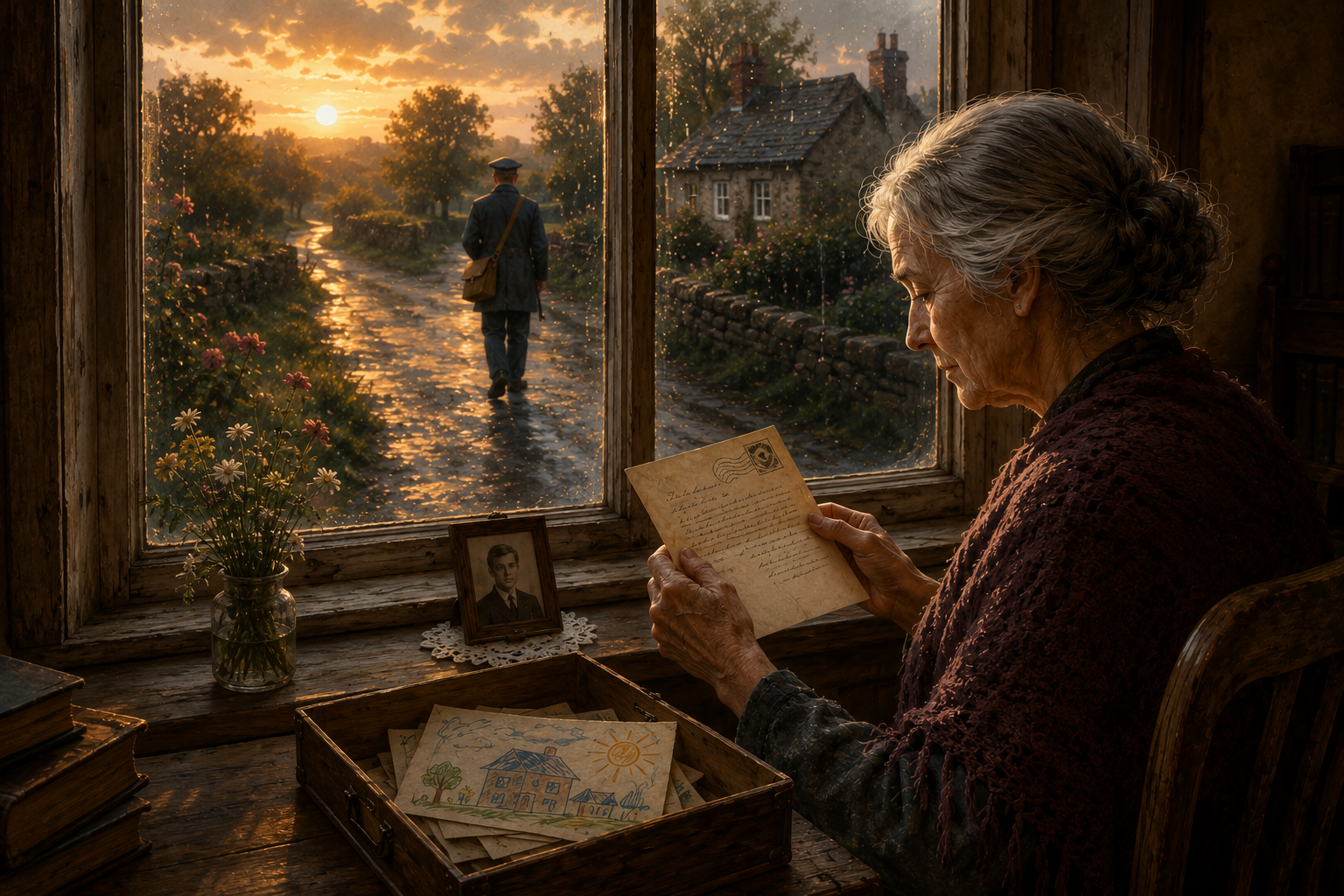
Every afternoon at four o’clock, Eleanor Whitmore carried a cup of tea to the same chair beside the window. She had done it for so many years that the ritual had outlived its reason. The tea was often cold before she remembered to drink it, and the cushion had taken the shape of her body, but still, at four, she sat down and looked toward the narrow country lane that disappeared beyond the stone wall.
People in the village believed she was watching for the postman. They were not entirely wrong. Yet Eleanor knew that what she waited for had become larger than a letter. It was an apology, perhaps. Or an explanation. Or simply proof that somewhere in the world her son still remembered the road home.
James had left twenty-seven years earlier on a bright September morning. He was nineteen, impatient, handsome, and certain that life was waiting for him somewhere beyond the hills. His suitcase was too small, his coat too thin, and his confidence enormous. Eleanor had stood at the gate until the bus disappeared, one hand raised long after there was no one left to see it.
At first, he wrote every Sunday.
His letters came from rented rooms and noisy streets, from jobs that never lasted and dreams that changed with the seasons. He wrote about a factory, then a theatre, then a woman named Clara whom Eleanor never met. Sometimes there were photographs. Sometimes only a few hurried lines. But every envelope carried the same promise somewhere near the end:
Then the letters became less frequent. A month passed. Then three. Then a year. Eleanor continued writing even when she no longer knew where to send her words. She kept the unsent letters tied with a blue ribbon in the bottom drawer of her desk.
She never told anyone how many there were.
On a rainy Thursday in October, the postman arrived later than usual.
Eleanor noticed him before he reached the gate. He was walking slowly, with his leather bag pressed against his side. For one strange moment she felt the old excitement rise inside her — so suddenly and sharply that she almost laughed at herself.
Then she saw the envelope in his hand.
The postman removed his cap.
“Mrs. Whitmore,” he said, “I don’t quite know how to explain this.”
The envelope was yellowed at the edges. One corner had been damaged by water. Across the front, beneath a row of faded stamps, was her name.
And the handwriting belonged to James.
Eleanor did not open it immediately.
She carried it into the house with both hands, as though it were something alive. She placed it on the kitchen table. She boiled water. Forgot the water. Boiled it again. Outside, rain moved softly against the windows, and somewhere in the distance a dog barked twice and fell silent.
Only when evening came did she break the seal.
The first line was enough to make her stop breathing.
James wrote that he had thought of her every day. He wrote that pride was a foolish thing, and that years could disappear while a man was busy believing there would always be more time. He wrote about mistakes Eleanor had never known, about loneliness he had hidden from everyone, and about the old house that returned to him in dreams.
He remembered the kitchen lamp.
He remembered the apple tree.
He remembered how she used to stand at the gate and wave.
Eleanor read more slowly as the page began to tremble in her hands.
Near the bottom, James had written:
Eleanor looked toward the window.
It was Thursday.
And it was raining.
For several minutes she sat without moving. Then she turned the envelope over and looked at the postmark.
The letter had been sent six months earlier.
Her son had died three months ago.
A policeman from another city had telephoned in July. There had been an accident, he said. James Whitmore had been carrying no family address, only an old photograph of a woman standing beside a garden gate.
Eleanor had buried him beneath the apple tree.
She pressed the letter to her chest and closed her eyes.
“Too late,” she whispered.
At that exact moment, someone knocked on the front door.
Eleanor opened her eyes.
The house was silent again.
Then came a second knock.
Three slow taps.
She rose from the chair.
Outside, the rain had grown heavier. Water ran down the glass in silver lines, distorting the lane, the stone wall, the dark shape of the gate.
Eleanor walked through the hallway and opened the door.
No one was there.
Only rain.
Only the empty path.
She was about to close the door when she noticed something lying on the step.
A train ticket.
Old. Damp. Folded once through the middle.
Her fingers went cold as she picked it up.
The destination printed across the front was the name of her village.
The date was six months ago.
And on the back, in James’s handwriting, were four words:
Eleanor stood in the doorway for a long time.
Then, very slowly, she smiled.
She did not ask how the ticket had come there. She did not call the postman. She did not tell the villagers. Some things, she understood at last, lose their meaning when forced into explanations.
She simply stepped back into the house and left the door open.
That night, the rain stopped shortly after midnight.
And for the first time in twenty-seven years, Eleanor Whitmore did not sit by the window at four o’clock the next afternoon.
On the kitchen table lay the letter, the old train ticket, and a cup of tea that was still warm.
Others arrive exactly when they are meant to.