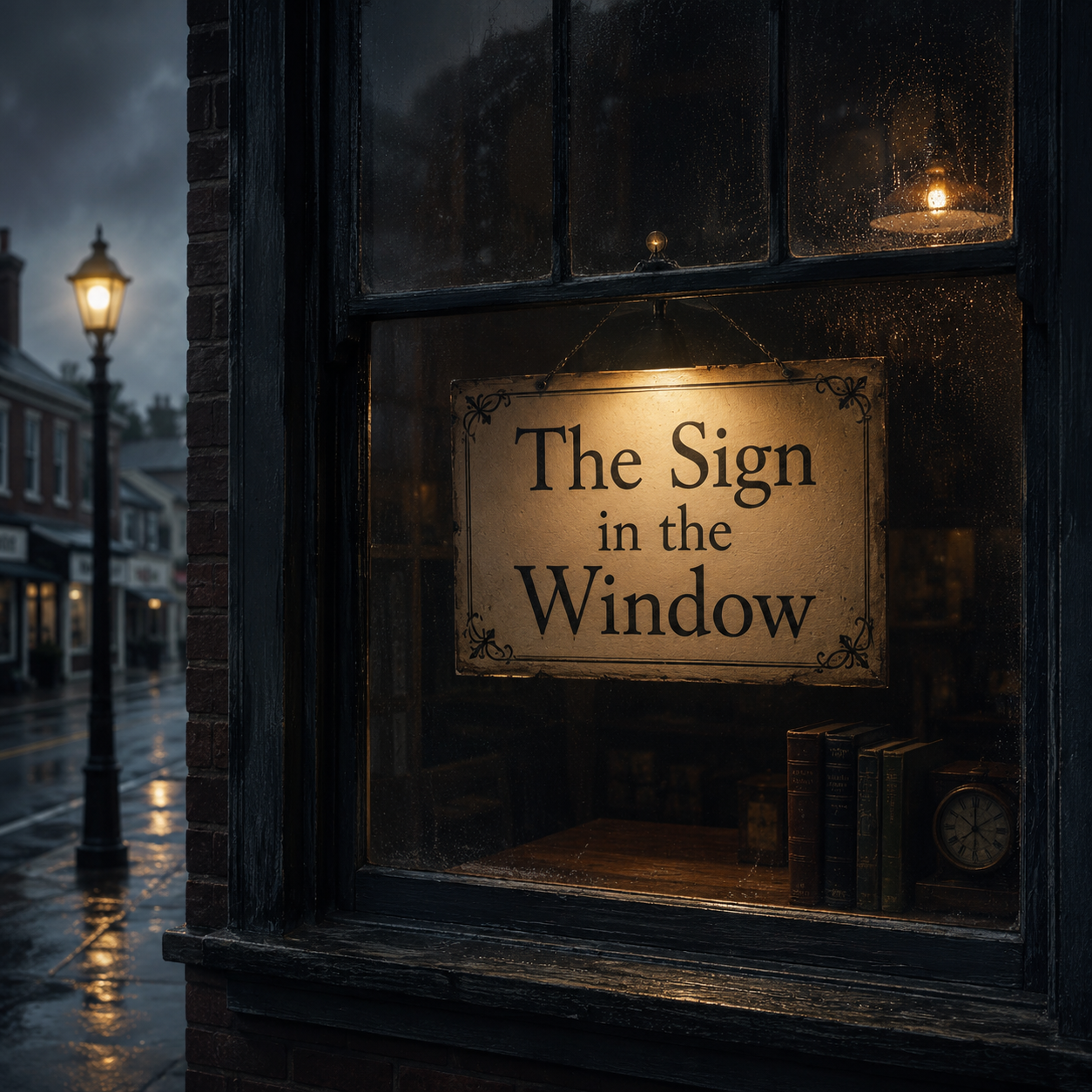
The Sign in the Window
The sign appeared on a Thursday evening, although Eleanor Vale would later spend a great deal of time trying to convince herself that it must have been there before.
She noticed it because of the rain. Rain changed the town after dark, polishing the narrow street until every lamp had a second life beneath it. Eleanor had stopped under the awning of the pharmacy to search for her gloves when she happened to look across the road. Between the bakery and the boarded-up tailor shop stood a narrow building she had passed twice a day for nearly eleven years without once wondering what was inside. Its windows were dark, its brickwork almost black with age, and above the door hung no name.
That evening, however, a warm light burned behind the glass.
In the window hung a cream-colored sign.
Eleanor read it twice. Then, embarrassed by her own curiosity, she glanced behind her to see whether anyone else had noticed. A man hurried past with a newspaper over his head. Two girls ran laughing toward the bus stop. No one looked at the window.
She told herself it was an advertisement. A joke. Perhaps part of a shop display she had somehow failed to notice. Yet as she walked home, the sentence followed her with an intimacy she disliked. You were supposed to come yesterday. Not we were closed yesterday. Not come back tomorrow. The words sounded less like a notice than a reproach.
The next morning the building was empty again.
Eleanor crossed the street before work and stood directly in front of it. Dust filmed the inside of the glass. There was no lamp, no counter, no sign. Through the window she could make out only bare floorboards and a staircase disappearing into darkness. A small brass plate beside the door had been painted over so many times that whatever name it once carried was impossible to read.
She was still staring when Mr. Dallow, the pharmacist, unlocked his shop across the street.
“Thinking of buying it?” he called.
Eleanor smiled. “What used to be here?”
His expression changed so slightly that another person might have missed it.
“Nothing,” he said.
“Nothing?”
“Not for years.”
Then he went inside and shut the door.
On Friday evening, the light returned.
Eleanor saw it from half a block away and stopped so abruptly that the woman behind her muttered something under her breath. The same amber glow filled the window. The same cream-colored card hung from two fine chains.
But the message had changed.
This time she did not go home.
She crossed the street, climbed the shallow stone step and tried the handle. The door was locked. She knocked once, then again. Somewhere deep inside the building, a floorboard creaked.
“Hello?”
No answer came.
Eleanor leaned closer to the glass. At first she saw only her own reflection: rain-dark hair, pale face, the collar of her green coat turned up against the weather. Then something moved behind her reflection.
A woman was sitting at a table in the back of the shop.
Eleanor froze.
The woman had her back to the window. She wore a dark blue dress, and her silver hair was twisted into a low knot. On the table before her stood two cups.
One of them was steaming.
Eleanor knocked harder.
The woman slowly lifted one hand.
Not in greeting.
She pointed toward the staircase.
At that exact moment, every light in the building went out.
Eleanor stumbled backward into the rain.
The window was empty.
So was the table.
And yet, through the glass, she could still see two pale circles in the dust where cups had been standing.
That night Eleanor dreamed of a red door.
In the dream she was six years old, although she knew this only in the peculiar way one knows things while dreaming. She stood in a hallway holding someone’s hand. The wallpaper was patterned with tiny gold birds. At the end of the corridor, a woman in a blue dress knelt down and fastened a silver chain around Eleanor’s neck.
“You mustn’t lose this one,” the woman said.
Eleanor woke before dawn with her hand closed around something.
For several seconds she lay still, listening to her own breathing. Then she opened her fist.
A small brass key rested in her palm.
She dropped it onto the bed.
Eleanor lived alone. Her apartment door had been locked. The windows were latched from inside. She searched every drawer, every box, every coat pocket, trying to persuade herself that the key had always belonged to her and that she had simply forgotten it.
At eight thirty she called her mother.
They had not spoken in four months.
“Do you remember a woman in a blue dress?” Eleanor asked.
Silence answered her.
Not confusion. Not surprise.
Silence.
“Mother?”
When her mother finally spoke, her voice had changed.
“Where did you see her?”
Eleanor sat down.
“I didn’t say I saw her.”
Another silence.
Then the line went dead.
The third sign appeared on Saturday.
By then Eleanor had spent the entire day searching old newspapers at the public library. She found the building in photographs from 1968, 1974 and 1981. In every picture it looked exactly as it did now: narrow, nameless, dark.
Then, shortly before closing, she found a photograph dated October 1987.
Eleanor had been born in 1986.
The photograph showed a crowd gathered for the town’s autumn parade. Children held paper lanterns. A brass band marched past the pharmacy. In the background stood the narrow building.
Its window was lit.
Eleanor enlarged the image on the library scanner until the faces dissolved into squares of gray. Behind the glass she could just make out a table, two cups and a woman in a dark blue dress.
Beside the woman stood a little girl.
Around the girl’s neck was a silver chain.
Eleanor stared at the photograph until the librarian touched her shoulder and told her they were closing.
Outside, rain had begun again.
Across the street, the window was glowing.
The new message contained only four words.
Eleanor stood beneath the streetlamp with the brass key in her coat pocket and understood, with a certainty that frightened her more than anything she had seen, that she had been carrying it long before she woke with it in her hand.
Not in her pocket.
Somewhere else.
Somewhere memory could not reach.
She crossed the street.
This time the key turned easily.
The shop was warmer than it should have been. A fire burned in a narrow iron stove, though there was no chimney. Shelves lined the walls from floor to ceiling, but they held no books. Instead, each shelf contained small objects arranged with museum-like care: a child’s red mitten, a wedding ring, a train ticket, a cracked watch, a hospital bracelet, a yellow ribbon, a pair of spectacles.
Lost things, Eleanor thought.
Then she noticed the labels.
Each object had a name beneath it.
Some names she recognized from the town. People who had died. People who had disappeared. People who had simply moved away and were never spoken of again.
At the back of the shop, the woman in blue sat waiting.
Up close, she looked older than Eleanor had imagined, perhaps eighty, perhaps a hundred. Her face was fine-boned and calm. Before her stood two cups of tea.
“You took your time,” she said.
Eleanor could barely speak.
“Who are you?”
The woman smiled sadly.
“That is not the question you asked the first time.”
Something shifted inside Eleanor’s mind.
A red door. Gold birds on wallpaper. Her mother crying. The silver chain. A man shouting downstairs. And herself — six years old, terrified — sitting at this same table while the woman in blue placed a brass key in her small hand.
Eleanor gripped the back of a chair.
“I was here.”
“Yes.”
“Why don’t I remember?”
The woman looked toward the shelves.
“Because you asked not to.”
Eleanor felt the room tilt.
The woman reached beneath the table and placed a small wooden box between them.
“Your mother brought you here after your father disappeared. You had seen something that night. Something she believed would destroy you if you carried it into adulthood.”
Eleanor stared at the box.
“My father drowned.”
“No.”
The word was quiet.
Absolute.
“His boat was found empty,” the woman continued. “That is not the same thing.”
Eleanor’s mouth went dry.
The woman pushed the box toward her.
“You left one memory here. Your mother paid dearly to make certain you would never ask for it back.”
“Then why call me now?”
For the first time, the woman looked afraid.
“Because yesterday,” she said, “someone came asking for you.”
The bell above the front door rang.
Eleanor turned.
A man stood outside in the rain.
He was old now. Thin. His hair almost white. But Eleanor knew him before memory had time to interfere. She knew the shape of his shoulders. The slight tilt of his head. The way his left hand rested against the glass.
Her father had been missing for thirty-three years.
He looked directly at her.
Then he raised one finger to his lips.
The woman in blue stood so quickly that her chair fell backward.
“Do not open that door.”
Eleanor could not move.
Outside, her father smiled.
And behind him, reflected in the rain-black street, stood dozens of people who were not there.
Men. Women. Children.
All facing the window.
All waiting.
The next morning, Mr. Dallow opened the pharmacy at eight as usual.
Across the street, the narrow building was dark.
The door was locked. Dust covered the glass. No footprints marked the pavement, although it had rained all night.
Eleanor Vale did not arrive at work on Monday.
She did not answer her phone. Her apartment was found locked from the inside, her coat hanging by the door and her shoes neatly placed beneath it.
Her mother refused to speak to the police.
Three weeks later, a young man waiting for the evening bus happened to glance toward the empty building between the bakery and the old tailor shop.
A warm light was burning behind the glass.
In the window hung a cream-colored sign.
He crossed the street to read it.
The young man dropped his umbrella.
He had never told anyone that he once had a sister.