Why We Look
to the Stars
Long before maps, compasses, clocks, or glowing screens, humanity was already asking the night sky where to go, when to begin, and what might be waiting beyond the darkness.
Before anyone asked a screen what tomorrow might bring, humanity asked the sky.
People lifted their eyes above silent deserts, restless seas, dark forests, fertile riverbanks, and cities whose names have almost disappeared from memory.
The stars became directions, calendars, stories, warnings, promises, and signs.
When the sky became a road
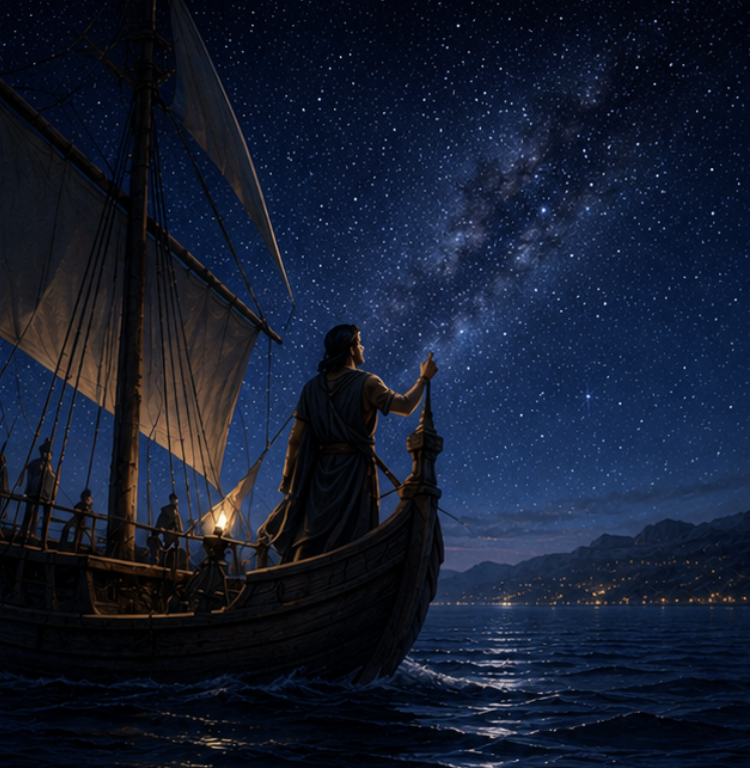
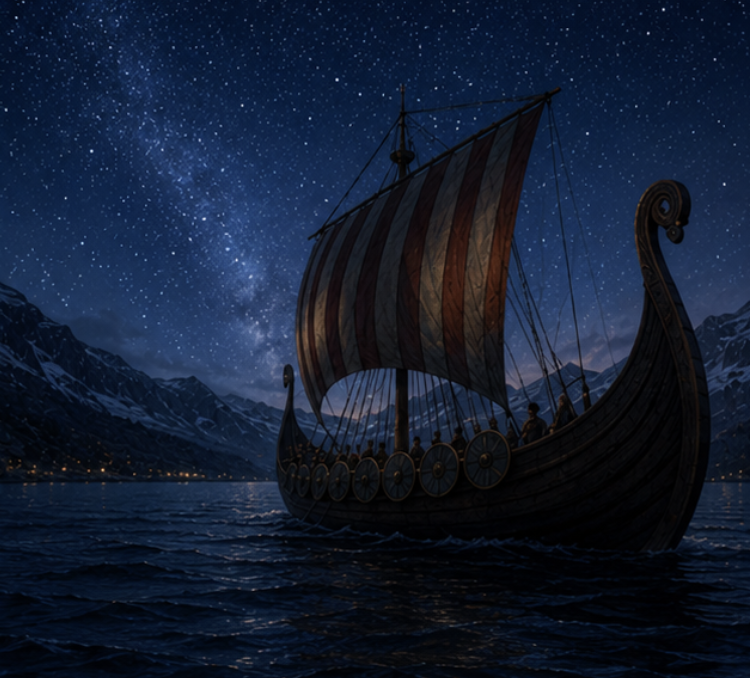
Imagine leaving the shore after sunset. Behind you, the familiar lights grow smaller. Ahead lies only black water, without a road, a signpost, or any promise that land will appear again.
There is no compass in your hand. No map can tell you exactly where you are. But above the mast, the heavens are moving in familiar patterns.
Certain stars rise from known places along the horizon. Others circle the northern sky. Their positions become a language learned through patience, memory, and generations of watching.
Sailors learned to recognize the shape we now call the Great Bear, or Ursa Major. Two bright stars at the outer edge of its familiar bowl could be used as pointers toward the northern sky.
When the shore disappeared, the stars remained.
When the heavens announced a season
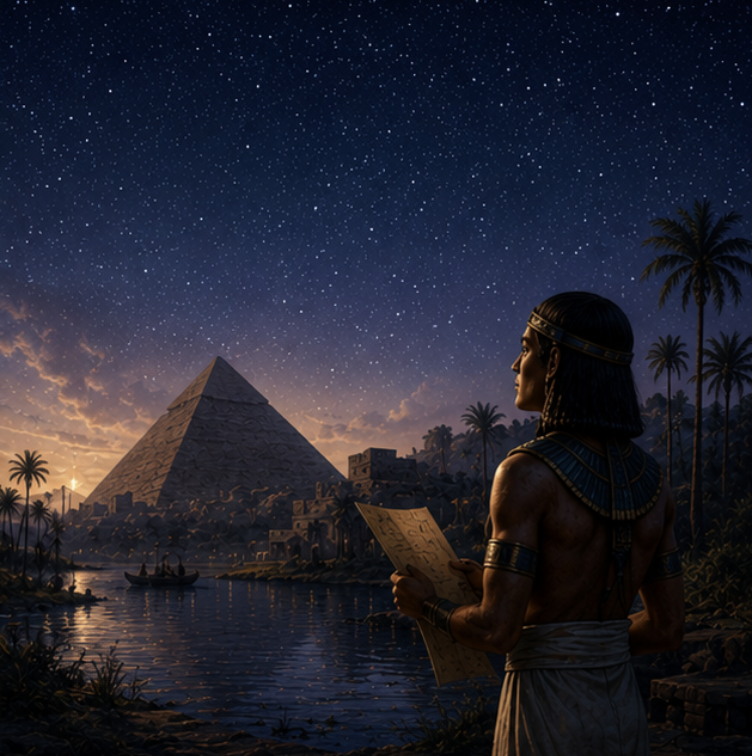
Along the Nile, looking upward was also a way of looking forward.
The river shaped life in ancient Egypt. Its seasonal rhythm influenced fields, harvests, journeys, ceremonies, and the survival of entire communities.
Sirius, the brightest star in the night sky, became closely associated with the turning of the Egyptian year. Its return to the dawn sky appeared near the season when the Nile’s annual inundation traditionally approached.
A distant light could therefore mean water, fertile soil, planting, work, and the beginning of another cycle. The future did not appear entirely hidden. It left patterns. It returned in seasons. Sometimes, it announced itself in light.
Above the river, a star whispered that change was near.
The night above the desert
In the desert, a path may vanish before morning.
Wind erases footprints. Sand reshapes the horizon. A landmark that seemed close in daylight can disappear into heat, distance, and darkness.
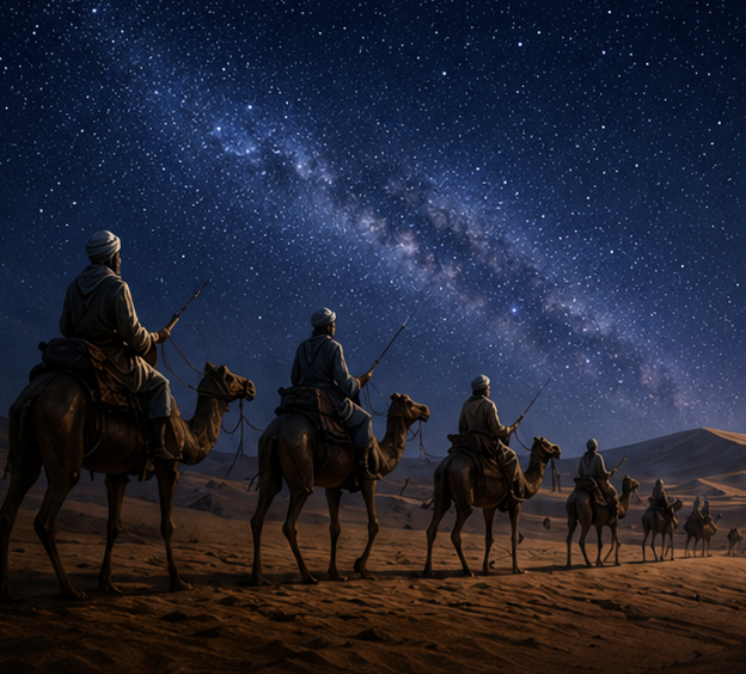
Caravans moved beneath the cooler night sky, watching where familiar stars rose and set. Knowledge of the heavens became part of the knowledge required to cross a landscape without roads.
Under the Milky Way, the desert was not empty. It was covered by an older compass. The stars that guided ships across water now guided travelers across a sea of sand.
Perhaps this was one of humanity’s earliest lessons in trust: the road may disappear beneath your feet while direction still exists above you.
The star that seemed to stand still
Northern waters demanded a different kind of courage.
Sailors faced fog, sudden storms, changing winds, and long stretches of sea where certainty could disappear in a single night.
In the northern sky, stars appear to turn around a celestial point. Polaris lies close to that point and has long served as a practical marker of north.
Polaris also forms the end of the handle of Ursa Minor, the Little Bear. Because it seems almost motionless while other stars circle around it, it became one of the night sky’s most recognizable signs of direction.
To an exhausted traveler on dark water, one steady light could feel like a promise: you are not entirely lost.
Direction does not always shout. Sometimes it waits quietly in one place.
The stars did not merely decorate the night. They helped humanity move through it.
The Maya and the architecture of time
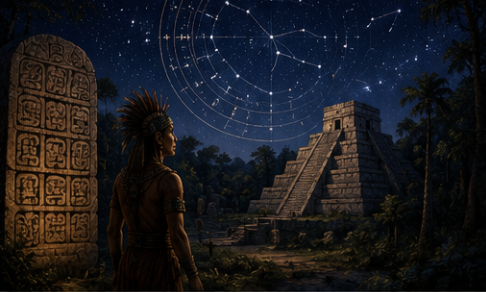
In Mesoamerica, generations of Maya skywatchers studied the heavens with extraordinary attention.
They observed the Sun, the Moon, stars, and the brilliant appearances of Venus. Through astronomy and mathematics, they developed interwoven calendar systems that organized time, preserved historical dates, and marked ceremonial life.
Light and shadow entered architecture. The positions of sunrise and sunset mattered. Celestial movements became part of a larger understanding of seasons, agriculture, ceremony, and cosmic order.
Time was not simply a line disappearing into the distance. It unfolded through cycles—days returning within larger patterns while human lives changed beneath them.
The sky did not offer a simple list of future events. It revealed something more profound: life has rhythms, and timing has meaning.
When celestial patterns became personal
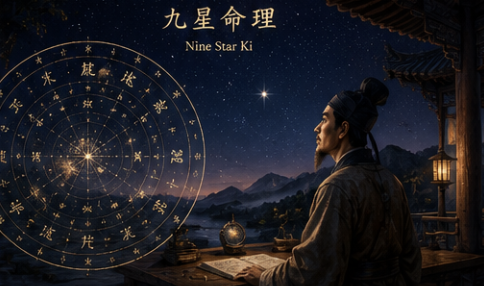
Over time, people did not only ask how the heavens moved. They also asked whether those movements might reflect the hidden patterns of a human life.
East Asian cosmological traditions explored relationships among time, direction, natural cycles, numbers, and human character.
Modern Nine Star readings often use birth dates to describe symbolic energies, tendencies, timing, and the dynamics between two people.
Why do certain people feel familiar the moment we meet them? Why do some relationships bring peace while others awaken old fears? Why do two lives cross at one particular moment?
Perhaps a compatibility reading does not decide whom we should love. Perhaps it gives us another language for noticing what already exists between us.
Sometimes we search the heavens because another person has become our greatest mystery.
For thousands of years, people looked upward to ask: Where am I going?
Why we still look up
Today, satellites can locate us within seconds. Maps glow in the palms of our hands. Weather forecasts warn us about approaching storms.
We no longer need the stars to cross an ocean or find the road home.
And yet, when life becomes uncertain, we still look for signs. We notice repeated numbers. A song arrives at the exact moment we needed it. A dream refuses to be forgotten. A feeling quietly tells us that something is about to change.
We once asked the sky, “Which way is north?” Now we ask: “Should I stay?” “Will love return?” “Is this the right time?” “Why did this person enter my life?”
Perhaps we have never stopped looking for direction. We have only changed the destination.
The sky does not promise certainty.
But sometimes a symbol, a card, an ancient verse, or a quiet message gives us enough distance to recognize what our own heart has been trying to say.
MySoonish was created for those moments—not to command the future, but to pause beneath it, listen carefully, and notice what may already be beginning.
MySoonish readings are created for reflection and entertainment. Your choices, judgment, and future always remain your own.